
▶ Video Feature
By Rafe Britton
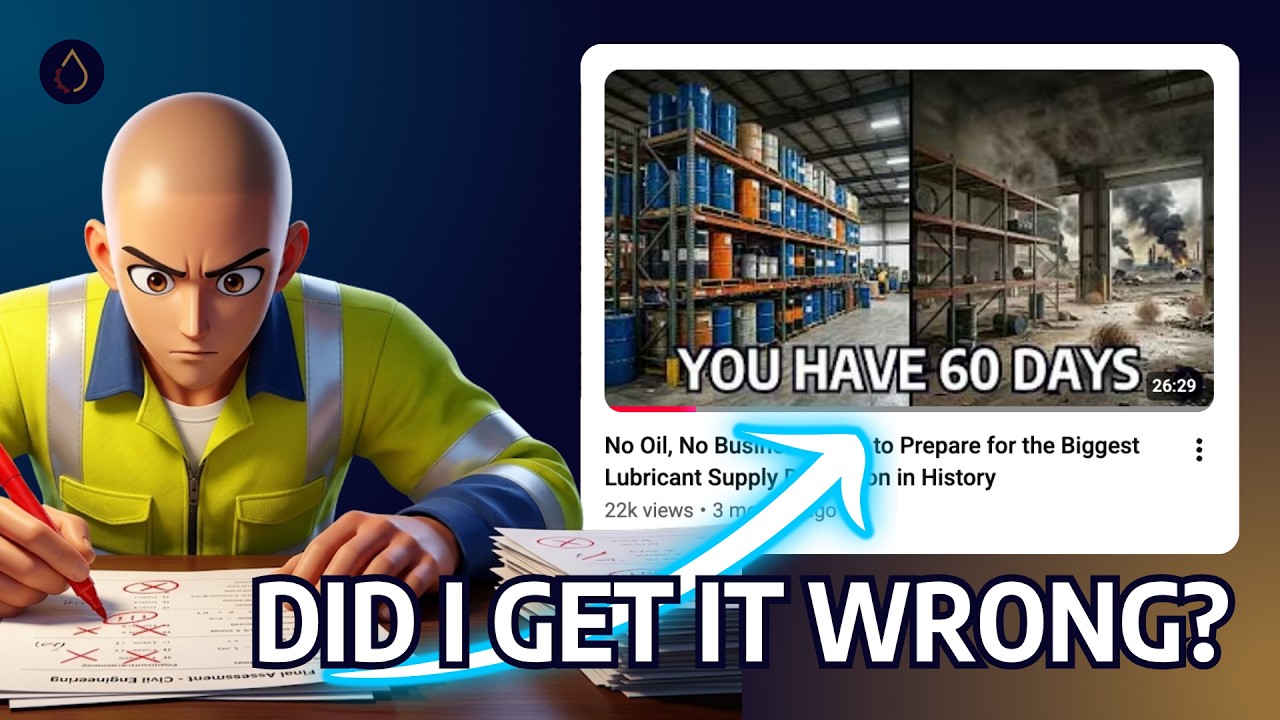
Back in April I published a video arguing that the lubricants industry was facing the most significant supply chain disruption of the modern era, and that readers had roughly 60 days to act. It was a big claim, and it drew a fairly even split of agreement and accusations of scaremongering.
Four months later, I thought the honest thing to do was go back and mark my own homework. This video is that reckoning, plus an update on how much the picture has shifted since.
The short version of the backdrop: strikes on Iran in February closed the Strait of Hormuz, a corridor carrying around 20 million barrels a day and, for our industry, the primary export route for Gulf base oils, additives and finished lubricants. June’s ceasefire lasted about a week.
Commercial transit through the Strait of Hormuz, relative to pre-crisis volume
Rise in marine insurance costs — where coverage can be obtained at all
Of US Group 3 base oil supply sidelined, according to ILMA estimates
Some of my original calls held up. Allocation and rationing did begin in May, as predicted. The Korean refiners, well outside the conflict zone but dependent on Middle East crude, went into constrained runs. And the argument that there was no safe harbour, that you could not simply switch from mineral to synthetic, proved correct.
Others did not. I called Group 1 “ground zero” when Group 3 has been the epicentre, with ILMA estimating around 44% of US Group 3 supply sidelined. I missed refinery economics entirely, where diesel margins are quietly pulling feedstock away from base oil production. And I overstated the packaging constraint.
Most significantly, I was watching the wrong part of the map. Saudi Arabia’s East-West pipeline to Yanbu was the workaround that made Hormuz survivable, until recent strikes on Jazan, Yanbu and Abqaiq closed that door too. Yanbu is not just a crude terminal. It hosts a major Luberef base oil facility that was days from bringing a significant expansion online. Abqaiq is one of the world’s largest sources of byproduct sulphur, in a market already up 130% this year, and sulphur is the foundation of ZDDP, sulphurised EP additives and sulphonate detergents.
The video covers where base oils, additives and finished lubricant pricing sit today, why recovery has moved from 2026 to deep into 2027, and the practical levers available to lubricant users right now. I would rather be corrected than comfortable, so if your experience on the ground differs from mine, I want to hear it.
Rafe Britton is a mechanical engineer and the host of Lubrication Explained.