

By Jorge Alarcon
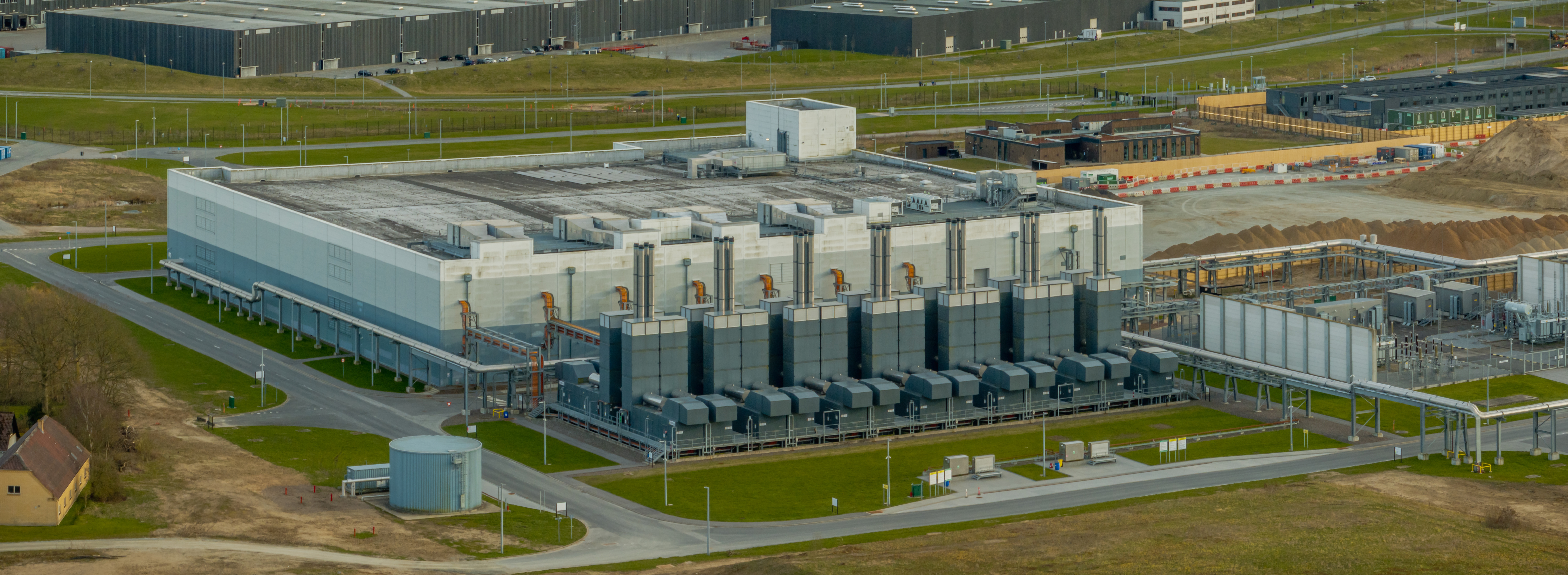
From an economic perspective, the construction of new data centers responds to a structural need: digitalization, artificial intelligence, and massive data storage are steadily driving up demand for computing capacity. However, this growth is not neutral. Each new data center requires highly capital-intensive investment, along with access to land, connectivity and, above all, a stable electrical supply.
Projected worldwide data center electricity consumption by 2030 — more than double today’s demand
Share of a data center’s energy that goes to cooling — from highly efficient to less optimized facilities
This means that, over the next 10 years, we will need not only more facilities but also more power generation, more grid infrastructure, and greater resilience across the energy system. In macroeconomic terms, the challenge will not be limited to building technological facilities; it will also require ensuring that electrical infrastructure grows at the same pace. Furthermore, a significant portion of that energy will not go to the servers themselves, but rather to keeping them within safe thermal ranges.
A Maintenance Reality, Not Just an IT Challenge
From an industrial maintenance standpoint, this reality completely changes the operational approach. A data center depends not only on servers and electrical systems, but also on a chain of auxiliary equipment that must operate continuously: pumps, heat exchangers, thermal treatment units, valves, sensors, and control systems. If any of these elements fail, the risk is significant: temperature rises, availability drops, and service continuity is compromised.
This is where the products that cool the cooling fluids become especially important, because in modern environments thermal management can no longer rely on air alone. Liquid circuits require coolants, dielectric fluids, or water-glycol blends that must retain their physical and chemical properties. To achieve this, maintenance must monitor degradation, contamination, corrosion, sludge formation, microbiological growth, and loss of heat-exchange capacity.
Experience shows that a poorly controlled fluid turns an efficient system into an unstable one.
For this reason, maintaining is not just repairing it means analyzing, preventing, and ensuring the health of the thermal circuit. In practice, this involves periodic inspections, sampling, monitoring of pH, conductivity and inhibitors, and cleaning of heat exchangers. If the fluid loses performance, cooling loses margin, which in turn shortens hardware lifespan and increases the center’s energy consumption.
Cooling Fluids: A Strategic Component
In this context, cooling fluids are much more than a simple heat-transport medium. They are what allows thermal energy to be extracted from equipment and moved to a system where it can be safely dissipated. They may be treated as water, glycol blends, or fluids specially formulated for direct cooling, depending on the data center’s architecture and the required thermal density level.
Their technical value lies in the balance between heat capacity, chemical stability, material compatibility, and risk control. When these fluids are properly selected and maintained, the system operates with greater efficiency, less wear, and higher reliability. That is why, in the new generation of data centers, cooling is not a secondary subsystem: it is a strategic component of both business and operational availability.
The failure of these fluids does not simply mean that a replacement must be planned; it generally has a direct impact on the entire system, requiring maintenance intervention, parts replacement, and a shutdown — planned or unplanned — that can carry a high cost due to operational downtime.
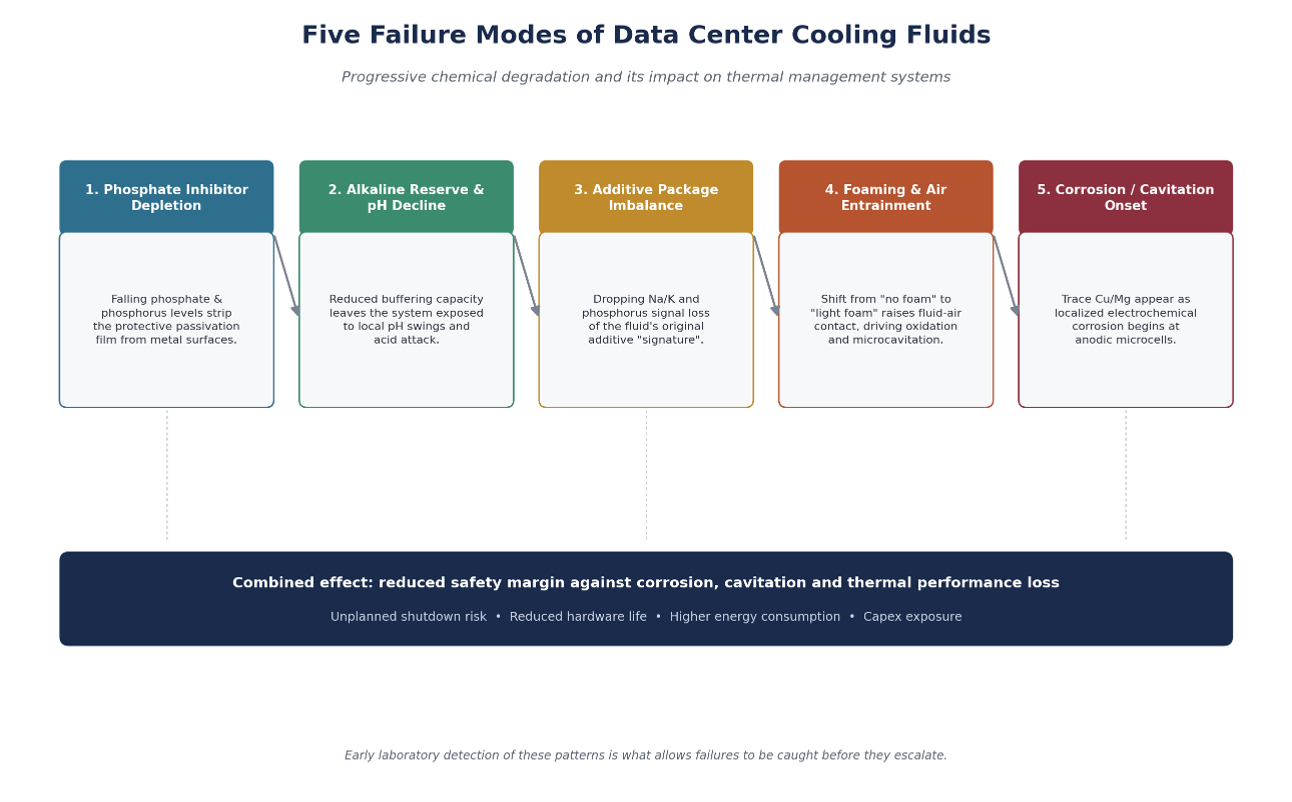
There is a wide variety of cooling fluids used in these systems, but many of them share common failure modes. This article covers five of these main failure modes, as well as their impact on the systems.
The Five Failure Modes of Data Center Cooling Fluids
Depletion of the Phosphate Inhibitor Package
A drop in phosphate, together with a decline in phosphorus, indicates real consumption of the inhibitor system rather than mere analytical variation. In these types of fluids, phosphate acts as part of the surface passivation mechanism, forming a protective film on the circuit’s metals; when this reservoir drops, the metal-fluid interface becomes chemically “bare” and much more vulnerable to electrochemical attack.
From a chemical standpoint, this means the fluid loses its ability to control corrosion kinetics in active areas of the system. It is not simply that “there is less additive,” but rather that the balance between inhibitor species, available alkalinity, and metal surfaces is disrupted, increasing the likelihood of intermittent depassivation.
Loss of Alkaline Reserve and pH Decline
A decline in alkaline reserve is accompanied by a drop in pH. This means the fluid has reduced buffering capacity to neutralize acids formed by oxidation, contamination, or thermal microdegradation; in practice, the system shifts from a “buffered” chemistry to one that is far more sensitive to local pH changes.
In terms of mechanisms, this favors the formation of local corrosion cells and accelerates the dissolution of protective layers, especially in the presence of flow discontinuities, trapped air, or elevated wall temperatures. pH is not yet in the acidic range, but the combined drop in pH and alkalinity signals that the fluid’s chemical defense capacity is already compromised.
Consumption and Imbalance of the Organic/Inorganic Additive Package
The decline in sodium and potassium, together with the drop in phosphorus, points to depletion of the formulation package and/or its chemical transformation during service. In complex fluids, these elements are not “wear metals,” but markers of the additive fraction: when they decrease, it usually indicates consumption through surface adsorption, carryover, precipitation, or reaction with oxidation byproducts.
In some cases, the appearance of molybdenum may be interpreted as an indication of contribution from the system or redistribution of additive-package species, although on its own it does not constitute a failure. What matters is the overall pattern: the fluid is losing its original chemical signature and shifting toward a composition less consistent with a “healthy circuit,” which in actual service tends to precede a loss of thermal performance and protection.
Foaming and Air Entrainment
The shift from “no foam” to “light foam” is chemically very significant, even though it may appear minor visually. Foam does not only indicate aeration; it also reveals a change in the fluid’s surface tension, the presence of surfactant contaminants, or degradation of the additive package that stabilizes/destabilizes bubbles.
From an operational standpoint, foam accelerates oxidation, because it increases the fluid-air contact area and promotes the formation of microbubbles in pumps and recirculation points. This can lead to microcavitation, loss of hydraulic continuity, and a drop in the heat-transfer coefficient — something especially critical in cooling systems like these.
Onset of Corrosion/Cavitation and Incipient Metal Release
Although wear metals remain low, copper and magnesium may appear at concentrations so low that they coincide with the analytical error margin of the testing equipment; however, if the analysis is performed by a laboratory experienced with this type of fluid, it will clearly flag the loss of passivating capacity and the risk of corrosion/cavitation damage. This is consistent with a scenario in which the fluid’s chemistry stops protecting surfaces and trace dissolution from circuit components begins to occur.
The mechanism here is not yet purely “mechanical wear,” but rather localized electrochemical corrosion: the reduction in phosphate and alkaline reserve causes zones with differences in oxygen, flow, or temperature to act as anodic microcells. If the process progresses, metallic traces appear first, followed — much later, closer to failure — by turbidity, and finally deposits, flow loss, damage to heat exchangers, and erosion/cavitation in pumps or piping elbows.
Technical Interpretation and Recommendations
In technical terms, the predominant failure is a progressive deactivation of the inhibitor package, with loss of buffering capacity and surface passivation, accompanied by incipient aeration that can accelerate oxidation and localized corrosion. The practical consequence is not only fluid aging, but a reduction in the cooled system’s safety margin against corrosion, cavitation, and loss of thermal performance.
Because analysis of this type of fluid is still in its early stages, only a handful of laboratories worldwide clearly understand these failure modes and how to detect incipient patterns before they occur — along with the associated costs, which can be substantial and directly impact operations and potentially the business’s capital expenditure, since a large part of the system may need to be replaced.