


Machinery Lubrication Level I — Pewaukee, WI
Four days of intensive training on industrial lubrication best practices — lubricant selection, storage, filtration, and application. Built for those pursuing MLT I / MLA I certification.
About STLE: A Legacy of Tribology
In 1944, the American Society of Lubrication Engineers (ASLE) was founded as a non-profit association to advance the knowledge and application of the science of lubrication and tribology. The society created a forum for the steel industry, enabling lubrication engineers to build a network of seasoned professionals to interact and grow. In 1987, it was renamed the Society of Tribologists and Lubrication Engineers (STLE) to better reflect its expanding scope across all areas of tribology.
What is Tribology?
Lubrication engineering relates to the reduction of friction and wear between relatively moving parts. The term tribology was coined in the mid-1960s in Great Britain to describe the study of interacting moving surfaces — derived from the Greek word “tribos” (the science of rubbing). Tribology encompasses physics, chemistry, applied mathematics, metallurgy, material science, mechanical engineering, chemical engineering, and applied mechanics.
Origins of the CLS Certification
In 1990, a group of STLE members led by Richard E. Rush, Tom Lantz, Dan McCoy, and Larry Cole formed a committee to create one of the first STLE Certified Lubrication Specialist™ (CLS) exams. The exam was designed for the applied, hands-on individual responsible for keeping industrial machinery operating — with a deliberate emphasis on practical application over theory.
Exam Format and History
The CLS exam was first administered at the 1993 STLE Annual Meeting in Calgary, Alberta. Of the 25 initial candidates, 18 achieved a passing grade. The original format was a fill-in-the-blank exam, requiring test takers to know the body of knowledge thoroughly in order to answer succinctly and accurately.
In 2011, the format shifted to a 100 (150 Question) -question multiple-choice exam — eliminating ambiguity in interpreting correct answers while covering the same 16 areas of field tribology that define the body of knowledge for a certified lubrication specialist.
Exam Integrity and Industry Standing
The validity and integrity of the CLS exam have been challenged over the years. To date, it has passed every challenge — upheld by strict guidelines handed down to all members of the STLE CLS Committee, ensuring the quality of each question and the research and documentation required to support the answers.
The CLS is considered the most extensive certification in the lubrication field and one of the most difficult to achieve. STLE has maintained a long-standing focus on certifying the best, not the masses. The program’s success has inspired other certification programs to emerge in the field — each with its own place in the growth of the lubrication world.
Pursuing the CLS: What to Expect
STLE offers a range of study resources for CLS candidates, including reference materials and recommended reading aligned to the exam’s body of knowledge, along with a curated list of exam prep partners. Connecting with other certified professionals in one’s network is also strongly encouraged — often one of the most valuable parts of the preparation process.
Eligibility is based on a combination of education and relevant work experience. Many candidates are surprised to find they already qualify before beginning formal preparation. Employers are often willing to support the investment once they understand the value it brings: greater technical competence, reduced operational risk, and stronger professional credibility.
The STLE CLS Committee currently comprises 16 subject matter experts from across the industry, continuously updating and reviewing the question bank. Once earned, the CLS designation is valid for three years and renewed through a flexible combination of professional development activities — a process recently revised to better accommodate working professionals.
| Committee | 16 subject matter experts across all exam domains |
| Languages | English · German · Spanish (available July 1) |
| Exam Fee | $450 STLE members · $625 non-members |
| Validity | 3 years — renewable via professional development |
| Learn more | www.stle.org/certifications |
Table 1: CLS certification key facts.
The STLE Certification Suite
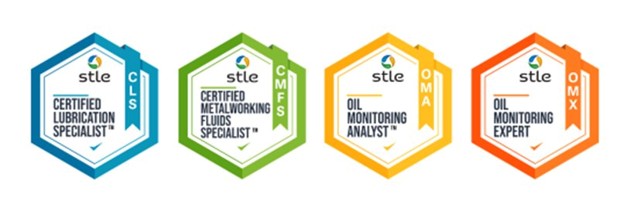
While the CLS remains the flagship credential in the lubrication world, STLE has developed a broader suite of certifications to serve the full spectrum of tribology and fluid management professionals:
| Credential | Full Name | Target Audience |
|---|---|---|
| CLS | Certified Lubrication Specialist™ | Industrial lubrication professionals — the flagship credential |
| CMFS | Certified Metalworking Fluids Specialist™ | Professionals in metalworking fluid applications |
| OMA | Certified Oil Monitoring Analyst | Oil analysis & condition monitoring analysts |
| OMX | Certified Oil Monitoring Expert | Senior practitioners in oil monitoring |
Table 2: STLE’s four professional certifications.
Each credential carries its own body of knowledge, exam structure, and eligibility requirements — providing clear, recognized pathways for professionals across all areas of tribology. Together, they reflect STLE’s commitment to setting the standard for professional excellence across the industry.
A Closer Look at Each STLE Certification
All STLE certification exams are taken remotely — at home or in a private work environment — on a computer with a secure internet connection and webcam. Results are provided immediately upon completion. All certifications are valid for three years and require recertification to maintain status. Exam fees are $450 USD for STLE members and $625 USD for non-members (retake: $225/$305 respectively).