

The Lubricant That Doesn’t Lubricate
The fastest-growing fluid market for companies like ExxonMobil, Shell, FUCHS, Castrol, and Lubrizol has nothing to do with turbines, hydraulic presses, or gearboxes. It’s a stainless steel tank full of servers submerged in dielectric fluid.
The data center immersion cooling fluids market is projected to grow from roughly $190 million in 2025 to over $840 million by 2032, expanding at nearly 24% annually. By the broader measure of the total immersion cooling market, including hardware and integration, some analysts put the 2025 figure above $4 billion.
These fluids never form a hydrodynamic film. They never protect metal-to-metal contact. They carry no EP or AW additive packages. And yet the companies formulating and selling them are the same organizations that fill your lubricant reservoirs. The base stock chemistries, the supply chains, and increasingly the technical service models are converging.
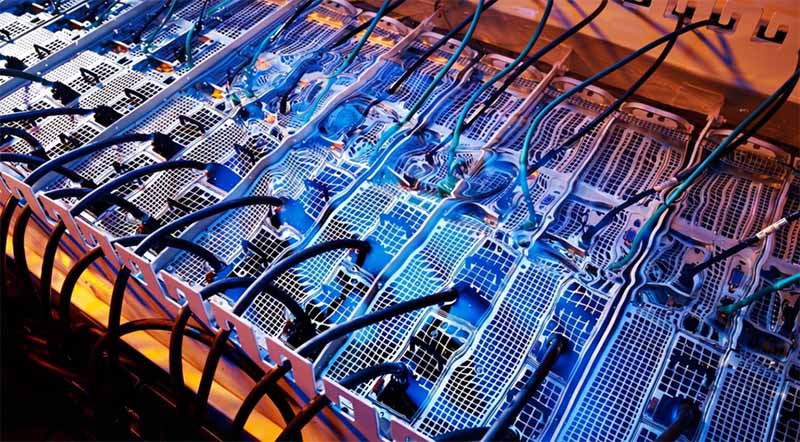
Figure 1: Server boards submerged in dielectric cooling fluid inside a single-phase immersion tank. The fluid, a synthetic hydrocarbon, absorbs heat directly from processors, memory, and power delivery components without the need for fans or airflow management.
Why “Lubrication” Is Moving into Thermal Management
Up to 40% of the energy consumed by a typical data center goes toward preventing it from overheating. That was manageable when servers ran at moderate power densities and air cooling could handle the load. It is no longer manageable. AI training clusters routinely push rack power densities above 50 kW, and next-generation GPU (Graphics Processing Unit) configurations are targeting 100 kW per rack and beyond. Air resists heat transfer, which is the reason that double-pane windows insulate a room so well. Water conducts heat roughly 25 times better than air at rest. In motion, the gap widens further.
A May 2025 lifecycle assessment published in Nature by researchers at Microsoft and WSP Global quantified the efficiency gains across three liquid cooling technologies compared to traditional air cooling. Cold plate systems delivered a 15% reduction in energy consumption and a 31% decrease in water use. Single-phase immersion improved those numbers to 15% and 45%, respectively. Two-phase immersion outperformed both, yielding a 20% energy reduction and 48% less water consumption.
Goldman Sachs estimates that data centers already consume 1–2% of global electricity, a figure that could nearly double by the end of the decade. In Ireland, data centers account for roughly 17% of national electricity consumption and could reach a third by 2026. The U.S. Department of Energy estimates domestic data centers used more than 4.5% of total U.S. electricity in 2025, with cooling systems responsible for 25–40% of that draw.
For the lubrication community, the conceptual shift is this: in rotating machinery, the fluid manages friction and wear, with heat removal as a secondary function. In data center immersion, heat removal is the entire job. The fluid’s role flips from tribological to thermal. But the underlying science of fluid chemistry, oxidation stability, contamination control, and condition monitoring is remarkably similar.
Up to 40% of the energy consumed by a typical data center goes toward preventing it from overheating. Water conducts heat roughly 25 times better than air at rest. In motion, the gap widens further.
Immersion Fluids vs. Traditional Lubricants: What’s the Same, What’s Not
Immersion cooling comes in two fundamental variants:
Single-phase immersion uses synthetic hydrocarbons (polyalphaolefins, gas-to-liquid bases), synthetic esters, or bio-based oils that remain in liquid state throughout the cooling cycle. The fluid circulates through a tank containing fully submerged servers, absorbs heat by convection, and transfers it to a heat exchanger. Synthetic hydrocarbons held roughly 41% of the 2024 market revenue, favored for their low viscosity and strong material compatibility. These are chemically familiar to anyone who has worked with Group IV or Group V base stocks.
Two-phase immersion uses fluorinated chemistries, including hydrofluoroethers (HFEs), perfluorocarbons (PFCs), and hydrofluoroolefins (HFOs), that boil at low temperatures, typically 50–60°C. The phase change from liquid to vapor absorbs significantly more heat per unit volume than single-phase convection. It’s thermally superior, but as we’ll discuss, it carries serious regulatory and supply chain risk.
What should feel immediately familiar to lubrication professionals is the list of fluid performance parameters. The Open Compute Project (OCP), the industry’s primary standards body for data center hardware, has published a Base Specification for Immersion Fluids that reads like a lube oil spec sheet translated into a different application. Viscosity targets, thermal conductivity requirements, flash point minimums, pour point behavior, oxidative stability expectations. The OCP specification sets a single-phase viscosity target of 1.5 × 10⁻² N·s/m² at 40°C (approximately 17cSt at at 40°C), noting that lower viscosity fluids allow higher fin density in heatsink design and better thermal performance overall.
What’s different is the failure mode. In rotating machinery, inadequate lubrication leads to metal-to-metal contact, adhesive wear, and ultimately seizure. In immersion cooling, the catastrophic failure is thermal runaway, where the fluid can no longer remove heat fast enough and server components exceed their thermal limits. Dielectric strength replaces film thickness as the critical performance metric. There are no wear particles to count, but there are degradation byproducts to monitor, contamination limits to enforce, and material compatibility issues that will sound very familiar.
Side-by-Side: Industrial Lubricant vs. Immersion Cooling Fluid
| Parameter | Industrial Lubricant | Immersion Cooling Fluid |
|---|---|---|
| Primary function | Friction reduction, wear protection | Heat removal, dielectric insulation |
| Base chemistries | Group I–V mineral & synthetic oils | PAO, GTL, synthetic esters, bio-oils, fluorochemicals |
| Viscosity focus | Film thickness at operating temp | Flow through heatsink fin channels |
| Additive packages | EP, AW, antioxidants, demulsifiers, many others | Minimal; antioxidants, metal deactivators |
| Failure mode | Wear, seizure, varnish deposition | Thermal runaway, dielectric breakdown |
| Key monitoring metric | Wear metals, viscosity, acid number | Dielectric strength, viscosity, acid number |
| Contamination control | ISO cleanliness codes, moisture | Particulate (≤25 μm), moisture, ionic residues |
| Material compatibility | Seals, paints, coatings | Cables, adhesives, PCB substrates, plastics |
| Operating temp range | 40–120°C typical | 40–70°C, continuous 24/7 |
| Regulatory exposure | REACH, GHS, waste oil disposal | PFAS restrictions (two-phase), REACH, GHS |
The Risk Landscape: Material Compatibility, Oxidation, and Contamination
The risks that data center operators are discovering are risks that lubrication professionals have been managing for decades.
Material compatibility is the most immediate concern. OCP’s material compatibility guidelines, published as an open-source reference document, warn that dielectric fluids can stiffen cable sheathing, remove identification markings, soften or dissolve adhesives and plastics, and interact unpredictably with certain coatings. The guidelines explicitly state that mineral oils should be avoided for immersion use due to impurities including sulfur, nitrogen, and aromatic compounds that create compatibility problems. Synthetic hydrocarbons and esters are the preferred chemistries.
Anyone who has managed a hydraulic system conversion or dealt with seal compatibility issues will be familiar with compatibility concerns. In a data center however, this concern is on a bigger scale. A single immersion tank can contain hundreds of servers, each with dozens of distinct materials in contact with the fluid. Cables, connectors, thermal interface materials, PCB substrates, conformal coatings, and adhesives all sit in the same bath. A compatibility failure is also on a larger scale than lubricants. Incompatibility doesn’t ruin a pump seal but destroys millions of dollars of compute hardware. Incompatibility examples can be seen in Figures 2 and 3.
A single immersion tank can contain hundreds of servers, each with dozens of distinct materials in contact with the fluid. A compatibility failure here doesn’t ruin a pump seal. It destroys millions of dollars of compute hardware.
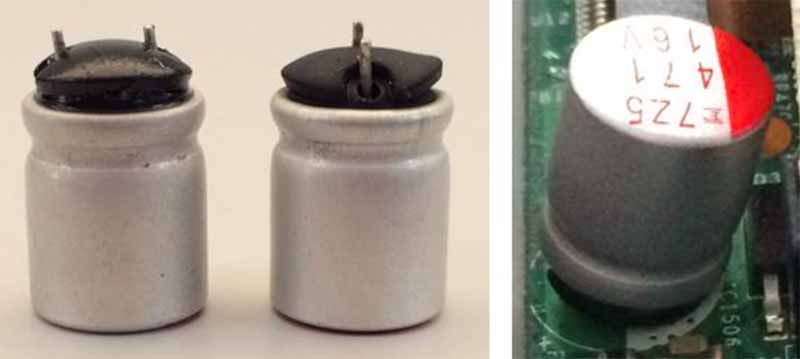
Figure 2: Incompatibility may show up in the swelling of EPDM sealing and bending of terminal leads
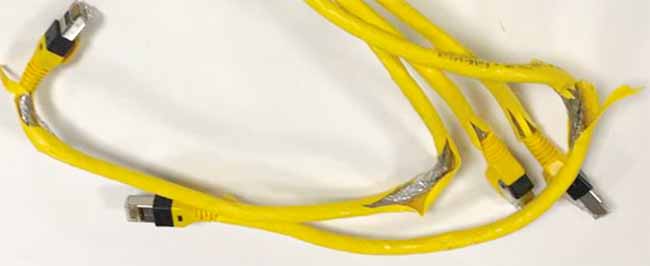
Figure 3: Plasticizers, chlorine, sulfur may dissolve into the dielectric fluid.
Oxidation and degradation follow familiar pathways but with a different stress profile. Even though immersion systems are often designed as closed-loop, oxygen ingress is never zero. At sustained operating temperatures (typically 40–60°C bulk, with localized hot spots near chips exceeding 80–100°C), the fluid undergoes the same radical chain oxidation you see in lubricating oils. The rate accelerates with copper exposure from bus bars, connectors, and heat sinks, which act as potent catalysts.
But the oxidative stress is relentless: 24 hours a day, 365 days a year, with no shutdown cycles, no seasonal variation, and no opportunity for the fluid to rest. Oxidative degradation proceeds, acid numbers escalate, and fluid properties deteriorate. Therefore, monitoring these parameters matter in a server tank just as much as it does in a critical compressor train.
Contamination sensitivity in data center cooling systems is similar to many industrial lubricant cleanliness requirements. OCP’s August 2025 Technology Cooling System (TCS) guidance specifies that microchannel heat exchangers require filtration to below 25 μm. The document emphasizes that fluid quality standards, detailed flushing procedures, and biofilm prevention protocols are essential for reliable operation.
Pipe materials prone to corrosion, particularly carbon steel, are prohibited. Pre-commissioning guidelines call for deionized water flushes meeting ASTM D1193 conductivity requirements, hydrostatic pressure testing, and documented cleanliness verification before the first drop of coolant enters the system. Anyone who has managed an EHC or hydraulic system to low NAS 1638 or ISO 4406 cleanliness codes will recognize the criticality of contamination control.
“Forever Chemicals” Split the Market in Two
No discussion of immersion cooling fluids is complete without addressing PFAS (per- and polyfluoroalkyl), also referred to as Forever Chemicals. This family of chemicals has incredibly strong carbon-fluorine bonds that do not break down in the human body or in the environment, leading to toxic bioaccumulation.
In December 2022, 3M announced it would stop manufacturing all PFAS chemicals by the end of 2025. That single decision effectively destroyed the supply chain for two-phase immersion cooling in data centers. The three fluids that made the technology possible, Novec 7100, Novec 649, Fluorinert FC-72, are gone. The last day to place a new Novec order was March 31, 2025. 3M was staring down over 4,000 lawsuits and a $12.5 billion settlement with more than 11,000 U.S. public water systems alleging PFAS contamination in drinking water.
The three fluids that made two-phase immersion cooling possible, Novec 7100, Novec 649, Fluorinert FC-72, are gone. One corporate decision wiped out the entire supply chain.
The regulatory pressure extends well beyond 3M’s exit. The European Chemicals Agency (ECHA) is evaluating a PFAS restriction proposal submitted by five EU member states under REACH that covers over 10,000 substances. Updated proposals published in August 2025 expanded exemptions from 26 to 74, including longer transition periods for certain heat transfer applications. ECHA’s final opinions are expected by end of 2026, with European Commission restriction legislation anticipated in early 2027. In the United States, the EPA has classified certain PFAS compounds as hazardous substances, imposing stringent waste management and reporting requirements. Several U.S. states are pursuing their own restrictions.
The practical result is a bifurcation in the immersion cooling market. Single-phase systems using hydrocarbon-based fluids (PAOs, synthetic esters, bio-based oils) are positioned as the safe, scalable path. They avoid PFAS entirely and use chemistries that lubricant companies already manufacture at industrial scale.
Two-phase systems are in limbo, waiting for Chemours and others to commercialize PFAS-free alternatives like HFO-based fluids with zero ozone depletion potential. Commercial production of Chemours’ Opteon 2P50 is targeted for 2026, and Samsung has already qualified the fluid. But as one industry analysis noted, any vendor building a two-phase product around a fluorinated fluid is building on ground that may shift under them within 18 months.
For the lubrication community, the PFAS collapse is more than a data center story. PFAS are used in specialty lubricants and greases due to their superior heat resistance, antiwear and anticorrosion properties. These regulatory changes require reformulation of hundreds of greases and lubricants. It’s a good reminder that supply chain resilience isn’t just about having a backup supplier. It’s about understanding the regulatory trajectory of your base chemistries.
Who Owns the Fluid Spec? OEM vs. Operator Dynamics
In industrial rotating machinery, the power dynamic around fluid specifications is well established. The OEM, whether it’s Volvo, Siemens Energy or Caterpillar, publishes an approved lubricant list. The end user follows it, often because the equipment warranty depends on compliance. Lubricant suppliers invest heavily in OEM approvals. The OEM holds the leverage.
Data centers have inverted this model.
OCP’s specifications are publicly available, their meetings are open and recorded, and their technical documents are published under Creative Commons licensing. The lubrication industry doesn’t have anything like it.
The Open Compute Project (OCP) sits at the center of the emerging standards landscape. OCP’s Immersion Sub-Project operates through dedicated technical committees for Fluids, Solutions, Reliability, and IT Equipment integration. These committees are developing open-source specifications, reference designs, and best practices through a volunteer-driven process that unites technology providers, end users, researchers, and fluid manufacturers. Their Immersion Requirements sub-project exists specifically to separate marketing claims from engineering reality, ensuring what OCP calls “accurate and factual technology positioning.”
This is an open-standards approach to fluid qualification that doesn’t have a clear parallel in traditional lubrication. ASTM and ISO develop test methods, but they don’t publish application-specific fluid requirements the way OCP does. OEM lubricant approvals are proprietary and often opaque. OCP’s specifications are publicly available, their meetings are open and recorded, and their technical documents are published under Creative Commons licensing.
Meanwhile, the hyperscalers are writing their own rules. Microsoft, Google, and Meta have internal testing programs and qualification protocols that effectively function as proprietary fluid specifications. When Microsoft validates a two-phase immersion tank at its Quincy, Washington campus, or when Google standardizes immersion-cooled TPU pods across its fleet, those decisions influence the market. The hyperscalers have more testing infrastructure, more purchasing leverage, and more operational data than any traditional OEM.
Chip manufacturers add another layer. In May 2025, Shell became the first immersion fluid provider to receive certification from Intel for its 4th and 5th generation Xeon processors, including a warranty rider for immersion-cooled chips. Intel estimated the electricity consumption reduction at up to 48%. This mirrors how turbine OEMs approve specific lubricant brands, but the twist is that Intel isn’t the system integrator; it’s the component manufacturer inside someone else’s machine.
Colocation providers and enterprise data center operators don’t have Google’s testing labs or Microsoft’s engineering teams. They need standardized, vendor-neutral fluid specifications they can trust. That is exactly the role OCP is filling, and it represents a model the lubrication industry could learn from. OCP’s transparent, committee-driven approach to fluid qualification stands in contrast to the often opaque process by which industrial OEMs approve or delist lubricants.
Why Lubricant Companies Are Repositioning Around Data Centers
The number of companies competing in the immersion cooling fluids market tells the story. Shell, ExxonMobil, Castrol, FUCHS, Lubrizol, Valvoline, TotalEnergies, PETRONAS, Cargill, and ENEOS are some of the major lubricant companies focused on data center immersion coolants.
Industrial lubricant volumes in traditional applications are mature in most developed markets. Electrification is shrinking some automotive and drivetrain lubricant categories. Data center fluids offer a new, high-growth volume play using chemistries these companies already manufacture. PAOs, synthetic esters, Group III+ bases, and bio-based oils are all viable single-phase immersion fluids.
Lubricant companies bring global supply chain scale, established quality management programs and technical service teams with decades of experience in condition monitoring and fluid analysis. In addition, they have deep institutional knowledge of oxidation chemistry, additive interactions, and degradation mechanisms. A lubricant company that already produces thousands of tons of PAO annually doesn’t face the same scale-up challenges as a venture-backed fluid startup trying to commercialize a novel chemistry.
Industrial lubricant volumes in traditional applications are mature. Electrification is shrinking some categories. Data center fluids offer a new, high-growth volume play using chemistries these companies already manufacture.
Oil manufacturers are also focused on the sustainability aspect. TotalEnergies’ BioLife product line demonstrates that plant-based fluid stocks can match petrochemical performance while biodegrading rapidly enough to satisfy EU waste directives. Cargill brings agricultural feedstock expertise. Bio-based lubricants have been a perennial topic at lubrication conferences for years. Data centers are giving the category a new, high-volume market to accelerate product development.
FUCHS has been particularly aggressive, signing a long-term partnership with Anhui Zhongding Intelligent Thermal Management Systems in China for data center immersion solutions in January 2024. Shell’s Intel certification positions it as the trusted fluid in one of the largest chip ecosystems on earth. Lubricant companies are quickly capitalizing on these emerging data center opportunities.
What This Means for Lubrication Professionals
The skills that define precision lubrication, fluid analysis, contamination control, material compatibility assessment, condition-based maintenance, and the ability to understand degradation mechanisms at a molecular level, are exactly what data center operators need as they transition from air to liquid cooling. The application is different. But the science is the same.
Consider what the OCP’s own documentation demands. Regular fluid testing with defined alarm limits. Material compatibility protocols. Cleanliness targets for particulate and ionic contamination. Flushing and commissioning procedures. Biofilm monitoring. Thermal performance trending over the fluid’s service life. These are the same program elements that world class lubrication programs require.
The data center immersion cooling market is growing at nearly 24% annually. The broader liquid cooling market nearly doubled in 2025, approaching $3 billion, and is forecast to reach $7 billion by 2029. Only 45% of data centers now run purely on air cooling, down from 48% just a year earlier, with 59% planning to implement liquid cooling within five years. This is a rapidly evolving market where fluids expertise will be demanded.
The definition of “lubricant” is expanding. It now includes fluids that never touch a bearing but carry the same chemical DNA, require the same analytical rigor, and depend on the same foundational science. The professionals who recognize this early won’t just watch the transition. They’ll lead it.
The Data Center Power Boom and What It Means for Traditional Lubrication Markets
The conversation about data centers and fluids tends to focus on what’s inside the server tank. Immersion cooling is new, it’s technically interesting, and it represents a genuine expansion of what the word “lubricant” means. But there is a second story running in parallel that may impact the lubrication industry’s bottom line. Power generation.
The scale of the power buildout is difficult to overstate. The International Energy Agency projects that global data center electricity consumption will roughly double to around 945 TWh by 2030, growing at about 15% per year. That growth rate is more than four times faster than electricity consumption growth from all other sectors combined. Gartner’s estimate is even higher, projecting worldwide data center electricity consumption will rise from 448 TWh in 2025 to 980 TWh by 2030. In the United States specifically, data centers consumed approximately 176 TWh in 2023, roughly 4.4% of total national electricity. The Department of Energy and Lawrence Berkeley National Laboratory project that figure could reach 6.7% to 12% of all U.S. electricity consumption by 2028.
Gas turbines are the biggest technology in this buildout. Natural gas supplied more than 40% of U.S. utility-scale electricity in 2023, and developers currently plan 18.7 GW of newly constructed combined-cycle gas turbine capacity through 2028. Globally, gas-fired power capacity in development rose 31% in 2025 alone, reaching a total of 1,047 GW across all stages of planning and construction. The Global Energy Monitor reports that 2026 could set a record for new gas power projects coming online, potentially exceeding the previous high of 100 GW added in 2002 during the wave of gas-fired construction that followed electricity market deregulation.
Data centers are a primary driver of this surge. Meta’s Hyperion project in Louisiana will use three H-class natural gas turbines as part of a facility that will eventually scale to 5 GW. Elon Musk’s xAI has ordered up to 60 gas turbines for its Memphis supercomputer facility. Boom Supersonic signed a $1.25 billion deal to supply Crusoe, an OpenAI data center developer, with 29 jet-engine-derived gas turbines. The Oracle/OpenAI Stargate project in Abilene, Texas is deploying GE Vernova and Solar Turbines units to deliver more than 1 GW of on-site power. Industrial Info Resources expects natural gas power plant investment to top $35 billion annually and sustain that level for several years, reaching a pace of construction not seen in two decades.
Gas turbine lead times have stretched to five to seven years in some cases, and turbine prices have risen 195% since 2019 according to Wood Mackenzie, reflecting the intensity of demand. OEMs like GE Vernova, Siemens, and Mitsubishi Heavy Industries report order backlogs at record highs.
Diesel generators represent a hidden fleet of enormous scale. Data centers require backup power systems capable of sustaining the full facility load during grid outages, and diesel generators remain the dominant technology. Just in the state of Virginia alone, over 10,500 diesel generator units had been permitted for data centers by the end of 2025, with a total capacity of 27 GW. That is equivalent to the power usage of roughly 20 million U.S. households, in a state with fewer than 4 million homes. Nationwide, the U.S. data center backup diesel fleet is expected to approach 67 GW of installed capacity by the end of the decade, roughly 35 nuclear power plants worth of generating capacity.
Virginia alone has permitted over 10,500 diesel generator units for data centers, with 27 GW of total capacity. That’s enough to power roughly 20 million U.S. households, in a state with fewer than 4 million homes.
A new class of power plant operator. More than 25% of new data center facilities above 500 MW will have behind-the-meter power generation by 2030, up from just 1% today. This means data center operators will be managing their own gas turbines, reciprocating engines, and combined-cycle plants, not the grid utility. Many of these data center operators have deep expertise in IT infrastructure and thermal management but no institutional experience managing rotating equipment maintenance programs. They will need lubrication engineers, fluid analysis programs, vibration monitoring, and contamination control technologies.
Renewables complete the picture. The data center buildout is simultaneously driving renewable energy procurement at unprecedented scale. Microsoft, Google, Amazon, and Meta are among the world’s largest corporate buyers of wind and solar capacity. In Europe, the major hyperscalers each account for roughly 4 to 9 GW of total corporate energy procurement.
The data center industry doesn’t just redefine what a lubricant is. It amplifies demand for every lubricant category that already exists: gas turbine oils, diesel engine oils, hydraulic fluids, wind turbine gear oils, and grease. Where turbines go, lubrication programs follow.
References
- Open Compute Project, “Immersion Sub-Project Overview,” OCP Cooling Environments, 2025. Available: https://www.opencompute.org/projects/immersion
- Open Compute Project, “Base Specification for Immersion Fluids,” Revision 1.0, Version 1.0, December 2022. Available: https://www.opencompute.org/documents/ocp-base-specification-for-immersion-fluids-20221201-pdf
- Open Compute Project, “Material Compatibility in Immersion Cooling,” Version 1.0, November 2022. Available: https://www.opencompute.org/documents/material-compatibility-in-immersion-cooling-document-version-1-0-nov-28-2022-1-pdf
- Open Compute Project, “OCP Immersion Requirements,” Revision 2.1, August 2023. Available: https://www.opencompute.org/documents/ocp-acs-immersion-requirements-rev-2-1-pdf
- Open Compute Project, “Modular Technology Cooling System for Cloud Scale,” Revision 1, August 2025. Available: https://www.opencompute.org/documents/ocp-modular-tcs-rev-1-final-2025-pdf
- Open Compute Project, “Guidelines for Pre-Commission Preparation of Technology Cooling System (TCS) Row Manifolds,” March 2025. Available: https://www.opencompute.org/wiki/Cooling_Environments/Immersion
- MarketsandMarkets, “Data Center Immersion Cooling Fluids Market by Technology, Data Center Type, Type, and Region – Global Forecast to 2032,” September 2025. Available: https://www.marketsandmarkets.com/Market-Reports/data-center-immersion-cooling-fluids-market-255406797.html
- Mordor Intelligence, “Data Center Immersion Cooling Market Size, Growth, Competition 2025–2030,” January 2026. Available: https://www.mordorintelligence.com/industry-reports/immersion-cooling-market-in-data-centers
- Microsoft and WSP Global, “Using Life Cycle Assessment to Drive Innovation for Sustainable Cool Clouds,” Nature, May 2025. Available: https://pmc.ncbi.nlm.nih.gov/articles/PMC12058514/
- Chemical & Engineering News, “Data Centers Take the Plunge,” C&EN, August 2025. Available: https://cen.acs.org/business/Data-centers-take-plunge/103/web/2025/08
- Data Center Dynamics, “Two-Phase Cooling Will Be Hit by EPA Rules and 3M’s Exit from PFAS ‘Forever Chemicals,’” February 2026. Available: https://www.datacenterdynamics.com/en/news/two-phase-cooling-will-be-hit-by-epa-rules-and-3ms-exit-from-pfas-forever-chemicals/
- The Cooling Report, “The Fluid That Made Two-Phase Immersion Cooling Work Just Became a Liability Worth $12.5 Billion,” March 2026. Available: https://thecoolingreport.com/intel/pfas-two-phase-immersion-cooling-crisis
- Grist, “The Trump Administration’s Data Center Push Could Open the Door for New Forever Chemicals,” December 2025. Available: https://grist.org/accountability/the-trump-administrations-data-center-push-could-open-the-door-for-new-forever-chemicals/
- Plastics Engineering, “PFAS-Free Liquid Cooling Hardware for AI Data Centers,” November 2025. Available: https://www.plasticsengineering.org/2025/11/pfas-free-liquid-cooling-hardware-for-ai-data-centers-010198/
- Network World, “Why AI Rack Densities Make Liquid Cooling Nonnegotiable,” March 2026. Available: https://www.networkworld.com/article/4149069/why-ai-rack-densities-make-liquid-cooling-nonnegotiable.html
- International Energy Agency, “Energy Demand from AI,” Energy and AI Report, 2025. Available: https://www.iea.org/reports/energy-and-ai/energy-demand-from-ai
- Gartner, “Gartner Says Electricity Demand for Data Centers to Grow 16% in 2025 and Double by 2030,” November 2025. Available: https://www.gartner.com/en/newsroom/press-releases/2025-11-17-gartner-says-electricity-demand-for-data-centers-to-grow-16-percent-in-2025-and-double-by-2030
- U.S. Congressional Research Service, “Data Centers and Their Energy Consumption: Frequently Asked Questions,” Report R48646, January 2026. Available: https://www.congress.gov/crs-product/R48646
- S&P Global Market Intelligence (451 Research), “Data Center Grid-Power Demand to Rise 22% in 2025, Nearly Triple by 2030,” October 2025. Available: https://www.spglobal.com/energy/en/news-research/latest-news/electric-power/101425-data-center-grid-power-demand-to-rise-22-in-2025-nearly-triple-by-2030
- S&P Global Market Intelligence, “Global Data Center Power Demand Expected to Almost Double by 2030,” November 2025. Available: https://www.spglobal.com/energy/en/news-research/latest-news/electric-power/110525-global-data-center-power-demand-expected-to-almost-double-by-2030
- Goldman Sachs, “AI to Drive 165% Increase in Data Center Power Demand by 2030,” February 2025. Available: https://www.goldmansachs.com/insights/articles/ai-to-drive-165-increase-in-data-center-power-demand-by-2030
- World Resources Institute, “Powering the US Data Center Boom: The Challenge of Forecasting Electricity Needs,” 2025. Available: https://www.wri.org/insights/us-data-centers-electricity-demand
- Carbon Brief, “AI: Five Charts That Put Data-Centre Energy Use – and Emissions – into Context,” September 2025. Available: https://www.carbonbrief.org/ai-five-charts-that-put-data-centre-energy-use-and-emissions-into-context/
- Kroll Tax Services, “Gas Turbines & the Data-Center Surge: Powering AI Growth,” Kroll Tax Insights Q1 2026. Available: https://www.kroll.com/en/reports/tax/kroll-tax-insights-q1-2026/gas-turbines-today-powering-hyperscaler-data-center-surge
- Gas Turbine World, “Powering the Data Center Boom,” November 2025. Available: https://gasturbineworld.com/powering-the-data-center-boom/
- Global Energy Monitor, “Betting Big on Data Centers, U.S. Now Leads World for New Gas Power Development,” January 2026. Available: https://globalenergymonitor.org/report/betting-big-on-data-centers-u-s-now-leads-world-for-new-gas-power-development/
- Marketplace (APM), “More Data Centers Plan to Build Their Own Natural Gas Plants for Power,” February 2026. Available: https://www.marketplace.org/story/2026/02/04/more-data-centers-plan-to-build-their-own-natural-gas-plants-for-power
- Turbomachinery Magazine, “Surging Gas Turbine Demand Fueled by Data Center, AI Growth,” December 2025. Available: https://www.turbomachinerymag.com/view/surging-gas-turbine-demand-fueled-by-data-center-ai-growth
- Bloomberg, “Gas-Turbine Prices Surge, Crimping Efforts to Power Data Centers,” April 2026.
- Mitsubishi Power, “U.S. Power Outlook for 2025 and Long-Term Trends: AI Data Center Boom Creates Opportunities and Challenges for Gas Turbine OEMs,” November 2025. Available: https://power.mhi.com/regions/amer/insights/us-power-outlook-and-long-term-trends
- Latitude Media, “The Data Center Boom Is a Diesel Generator Boom,” March 2026. Available: https://www.latitudemedia.com/news/the-data-center-boom-is-a-diesel-generator-boom/
- The National Interest, “AI’s Dirty Secret: Why Diesel Still Powers the Digital Age,” December 2025. Available: https://nationalinterest.org/blog/energy-world/ais-dirty-secret-why-diesel-still-powers-the-digital-age
- Power Engineering, “Onsite Gas Turbines, Reciprocating Engines to Power Meta Data Center,” June 2025. Available: https://www.power-eng.com/onsite-power/onsite-gas-turbines-reciprocating-engines-to-power-meta-data-center/
- Data Center Dynamics, “ProEnergy Repurposes Jet Engines to Power Data Centers Amid Gas Turbine Shortages,” March 2026. Available: https://www.datacenterdynamics.com/en/news/proenergy-offers-repurposed-jet-engines-to-data-cent/
- Grist, “Data Centers Are Scrambling to Power the AI Boom with Natural Gas,” February 2026. Available: https://grist.org/energy/data-centers-natural-gas-methane-behind-the-meter/