


Over the years, I have come across instances where issues have arisen, such as the filters blinding prematurely. With testing, this has ultimately been identified as leaving the tank open in a paper mill, and an investigation of the elements highlighted this, along with the high particle counts.
There have been other root causes, such as mineral oil being added to a phosphate ester oil on an electro-hydraulic control system, or, in another case, the oil supplier putting engine oil in drums intended for turbine oil. In the latter case, within less than an hour of topping up the turbine tank with just one of the mislabelled drums, the filters were showing as blocked, and the turbine was out of service for six months.
Within less than an hour of topping up the turbine tank with just one mislabelled drum, the filters were blocked, and the turbine was out of service for six months.
A more confusing scenario was a switch in supplier for a bearing oil at a paper mill. The end-user was assured of compatibility, but it transpired that a difference in the additive package, combined with water ingress (it was a paper mill after all), led to deposits on the filter. This could so easily have been checked by a filter-compatibility test from the new oil supplier. Filter companies often offer this service as well.
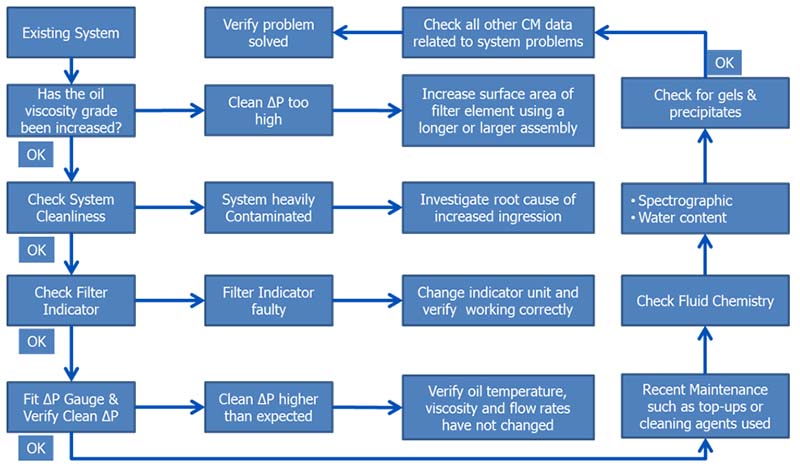
Consequently, I tend to use the following checklist when clients experience sudden, premature filter blockages in a previously stable system.
In the first instance, however, it is always useful to ask what the last maintenance action was, as this is often the cause or at least a clue to the possible cause.
While a number of these were major incidents involving high costs, I still frequently encounter the “oil is just oil” issue, and top-ups on smaller machines have been made with the wrong oil.
I still frequently encounter the “oil is just oil” issue, and top-ups on smaller machines have been made with the wrong oil.
Typically, I might get a phone call along the lines of “Is it possible to see if the wrong oil has been used for a top-up?” To which my answer is always, “Let me guess, you found the wrong container next to the asset?” Invariably, the answer is always yes.
Field Checks Before the Lab
So, when it comes to testing for the wrong oils used as top-ups, before even considering a laboratory test, there are a few basics to consider first.
| Simple Checks | Comment |
|---|---|
| Color | Only if the wrong oil is significantly different and ideally requires a comparable background to determine the change in color. |
| Smell/Odor | Only if the wrong oil is significantly different such as with Sulphur base EP oils. |
| Condition | Possible formation of gels or other insoluble product in the oil which may cause premature filter failures owing to increased pressure drops from the reaction by-products. |
| Temperature | Possible temperature change owing to incorrect viscosity – be aware that the temperature could go up if a higher viscosity is used but will go much higher if a lower viscosity is used. |
| Inspection | Increased levels of wear debris as seen on the mag-plug or when draining the oil. |
| Other Pointers | Incorrect containers left near the machinery. |
What the Lab Results Reveal
When it comes to laboratory testing, ideally, two samples need to be sent: a sample of the correct oil from a container in the store, along with the suspect sample from the asset. Using a sample of the correct oil, fresh from a container, a reasonable baseline for inorganic additive levels can be established and used for comparison with the suspect oil.
In terms of testing, however, apart from the obvious chemical and physical properties, measured wear rates may be affected by incorrect oil, which will elevate the measured wear metals.
| Oil Analysis Test | Comment |
|---|---|
| Viscosity | Only if the top-up oil is significantly different although there may be possible changes in the VI even if the viscosity is the same. |
| Acid Number | Only if the top-up oil is significantly different. |
| Base Number | Usually increases if top-ups occur but not ideal at identifying wrong oil unless non-engine oils have been used. |
| Elemental Spectroscopy | Useful at identifying additive element inconsistencies. |
| Fourier Transform Infrared (FTIR) | Probably the most effective test when compared against a new oil. Changes in Oxidation, Nitration and Sulphation levels, as well as Anti-Wear/Antioxidant levels, with potential reactions also showing. |
| Other Indicators | Changes in appearance, wear rates and RULER etc. |
Ultimately, though, several lessons spring to mind that we would do well to remember:
- Training and raising awareness of the need to avoid cross-mixing oils
- The use of a color code system for lubricants, with the color code visible on the new containers in stores, on handling equipment, and on assets.
- Guarantees backed up by insurance coverage from the suppliers when switching lubricant brands, but ideally, with technical testing.
- Certificates of conformity for all new batches of lubricants supplied.
- Random sampling of new oils, particularly for the high-cost assets.