
Temperature is a dominant factor influencing lubricant degradation, machine reliability, and overall asset performance. The widely accepted heuristic that lubricant life is reduced by half for every 10 °C increase in temperature is rooted in the Arrhenius equation, which describes the exponential relationship between temperature and chemical reaction rates.
This article presents a comprehensive analysis of thermally driven degradation mechanisms, supported by graphical interpretation, and discusses the implications for reliability-centered maintenance strategies.
Lubrication is a fundamental pillar of machine reliability, directly influencing friction, wear, and thermal stability. However, its effectiveness is strongly dependent on operating temperature.
Heat speeds up oil failure and quietly reduces its ability to do its job.
In industrial systems, even moderate temperature increases can significantly accelerate lubricant degradation while simultaneously reducing its load-carrying capacity creating a compounded reliability risk often underestimated in maintenance strategies.
Thermokinetic Fundamentals: The Arrhenius Equation
The degradation of lubricants follows chemical kinetics governed by the Arrhenius equation:
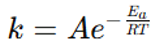
This equation demonstrates that reaction rates increase exponentially with temperature, forming the scientific basis for the widely used engineering rule:
For every 10 °C increase, lubricant life is reduced by approximately 50%.
The exponential nature of this relationship is illustrated below:
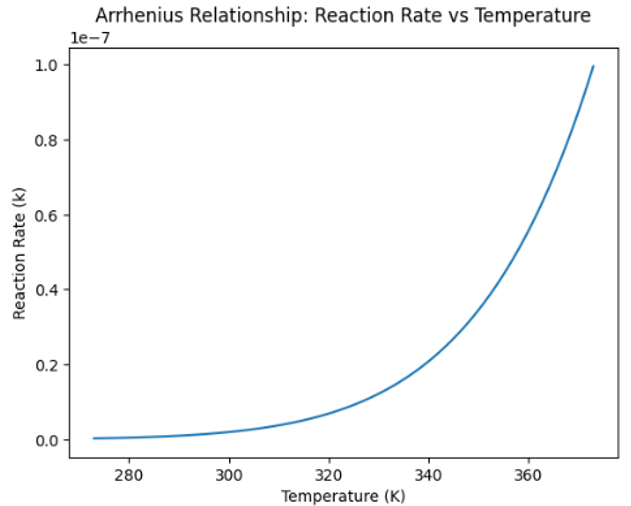
Technical Interpretation:
- Reaction rates remain relatively low at moderate temperatures
- Beyond a threshold, degradation accelerates sharply
- Small temperature increases result in disproportionately high chemical activity
This explains why oxidation, additive depletion, and oil breakdown escalate rapidly in elevated temperature conditions.
Thermally Driven Lubricant Degradation Mechanisms
Elevated temperatures initiate multiple degradation pathways:
- Oxidation acceleration (acid formation, sludge, varnish)
- Additive depletion (loss of antioxidants and anti-wear protection)
- Thermal cracking (molecular breakdown of base oil)
- Volatilization (loss of light fractions)
- Deposit formation (varnish and carbon residues)
These mechanisms are not independent – they interact synergistically, amplifying degradation rates.
Viscosity-Temperature Relationship and Lubrication Regimes
While temperature accelerates chemical degradation, it also directly affects lubricant physical properties, particularly viscosity.
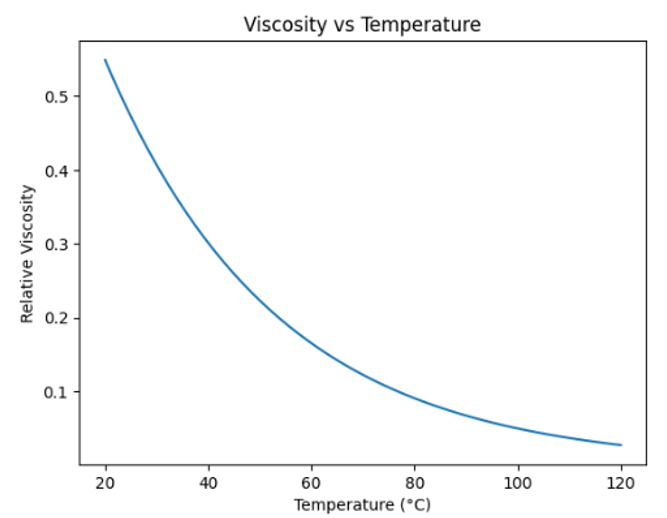
Technical Interpretation:
- Viscosity decreases exponentially with increasing temperature
- Reduced viscosity leads to thinner lubricant films
- Increased risk of metal-to-metal contact
This directly impacts lubrication regimes:
- Hydrodynamic → Mixed → Boundary lubrication
As viscosity drops, the lubricant loses its ability to separate surfaces, dramatically increasing wear rates.
Combined Effect: The Dual Degradation Mechanism
One of the most critical insights from reliability engineering is the simultaneous occurrence of two degradation processes:
- Chemical degradation accelerates (Arrhenius effect)
- Mechanical protection decreases (viscosity loss)
Key Insight
Temperature does not create a single failure mechanism it creates a compound failure environment.
This dual effect significantly increases failure probability, particularly in:
- High-load systems
- High-speed machinery
- Thermally stressed applications (compressors, turbines, hydraulics)
Impact on Machine Components
Bearings:
- Reduced film thickness
- Increased asperity contact
- Accelerated fatigue
Bearing life may be reduced by up to 50% under poor thermal and lubrication conditions.
Seals and Elastomers
- Thermal hardening
- Loss of elasticity
- Increased leakage and contamination
System-Level Effects
- Filter clogging (due to varnish/sludge)
- Reduced heat transfer efficiency
- Increased internal friction
Thermal Feedback Loop in Failure Development
A critical reliability concept is the self-accelerating failure cycle:
- Temperature increases
- Lubricant degrades
- Friction increases
- Heat generation increases
- Further degradation occurs
This feedback loop explains many catastrophic and unexpected failures in industrial systems.
Reliability Engineering and Maintenance Strategy
To mitigate thermal effects, organizations must adopt a proactive approach:
Monitoring
- Temperature sensors
- Infrared thermography
- Online oil condition monitoring
Predictive Maintenance
- Viscosity tracking
- TAN and oxidation analysis
- Particle counting (ISO 4406)
Prescriptive Actions
- Improve cooling systems
- Use synthetic lubricants with high thermal stability
- Control contamination
- Optimize lubrication intervals
Strategic Implications for Asset Management
Temperature control must be treated as a critical reliability variable, not a secondary parameter.
Organizations that integrate thermal management into lubrication strategies achieve:
- Increased MTBF
- Reduced downtime
- Lower maintenance costs
- Improved operational efficiency
Temperature is one of the most influential factors affecting lubricant performance and asset reliability.
The Arrhenius relationship and viscosity-temperature behavior clearly demonstrate that thermal effects simultaneously:
- Accelerate chemical degradation
- Reduce mechanical protection
This dual mechanism significantly increases failure risk.
Effective temperature control is not optional; it is essential for achieving high reliability and operational excellence.
References
- Bannister, K. (2007). Practical Lubrication for Industrial Facilities.
- Bloch, H. P. (2004). Machinery Failure Analysis and Troubleshooting.
- Fitch, J. (2012). Lubrication and Reliability Handbook.
- Harris, T. A. (2006). Rolling Bearing Analysis.
- Mortier, R. M. (2011). Chemistry and Technology of Lubricants.
- Moubray, J. (1997). Reliability-Centered Maintenance.
- Stachowiak, G. (2014). Engineering Tribology.
- ISO 4406 – Cleanliness Code
- ISO 55000 – Asset Management